



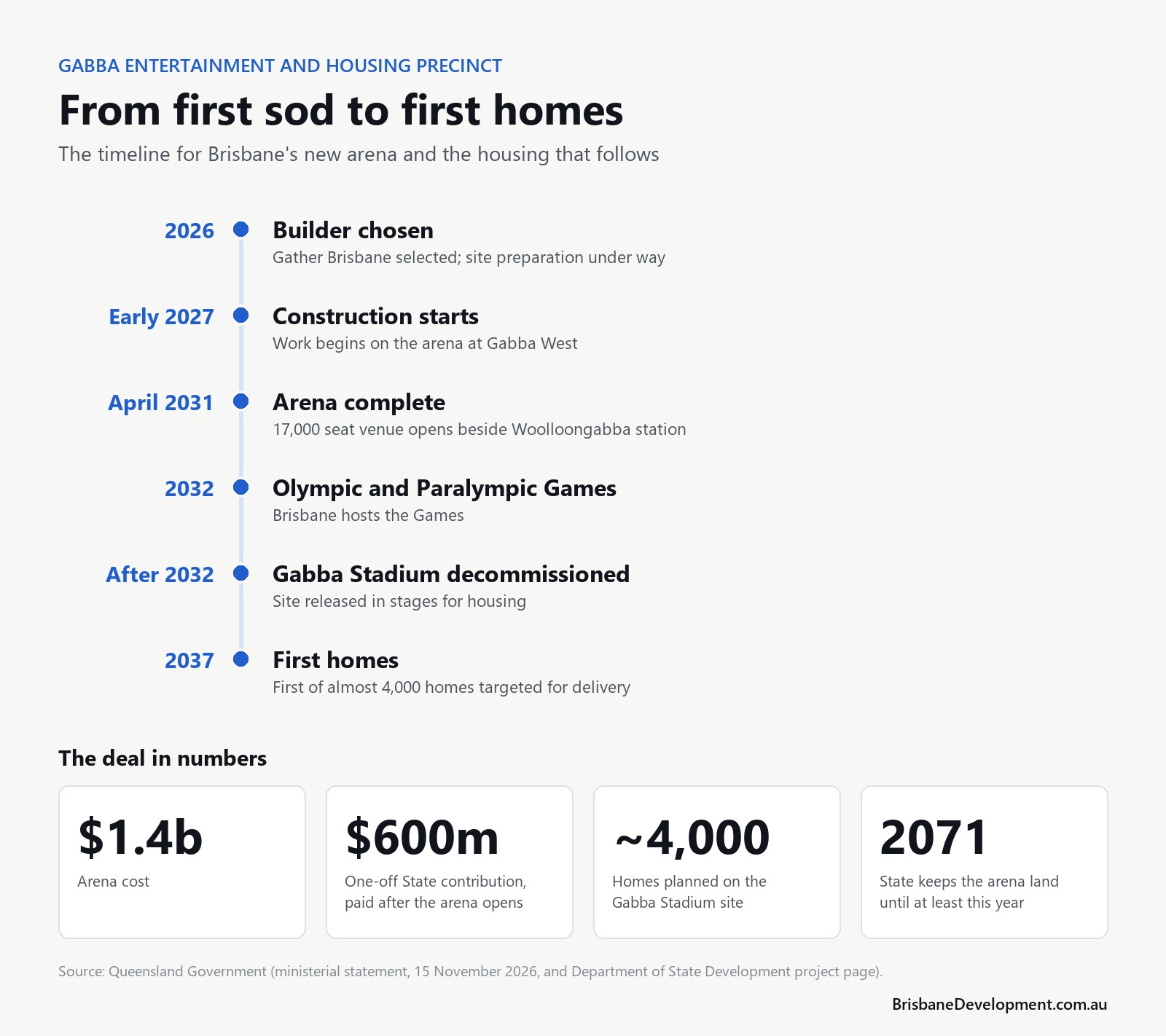
Brisbane finally has a builder, a design and a start date for its long-awaited inner-city arena. The Queensland Government has selected the Gather Brisbane consortium to deliver a $1.4 billion, 17,000 seat indoor arena beside the new Woolloongabba Cross River Rail station, with construction to begin early next year and the venue due to open in 2031.
The arena is the centrepiece of the wider Gabba Entertainment and Housing Precinct, which will also see the Gabba Stadium decommissioned after the 2032 Olympic and Paralympic Games and its site redeveloped with almost 4,000 homes, new public space, dining and bars.
Gather Brisbane brings together infrastructure investor Plenary, promoter Live Nation, venue developer and operator Oak View Group and builder Webuild. The consortium will design, build, finance, maintain and operate the arena, which will seat 17,000 for sport and hold up to 18,700 in concert mode. It will replace the 40 year old Brisbane Entertainment Centre at Boondall.

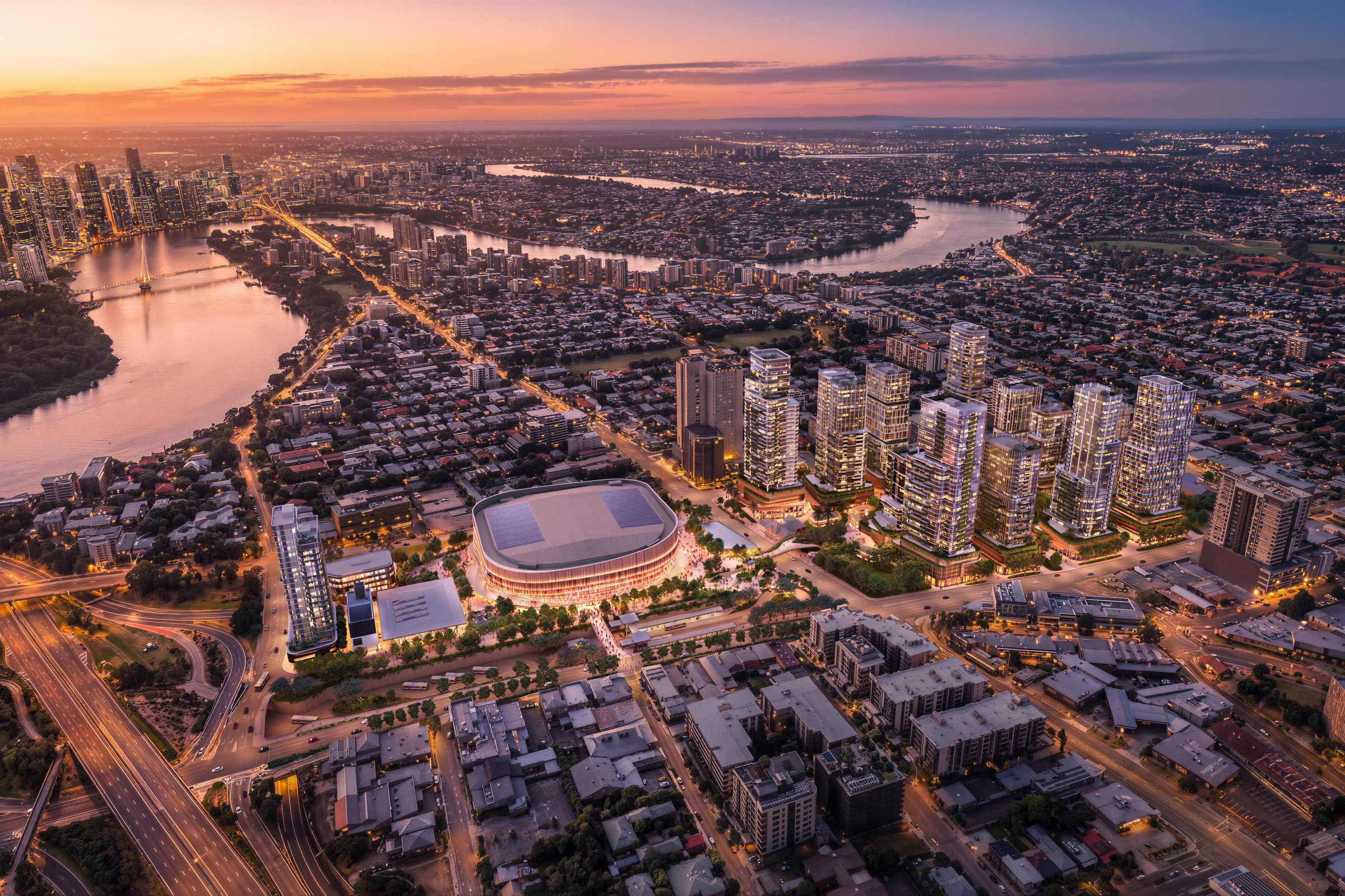
Renders released with the announcement show an oval building wrapped in vertical copper and bronze toned fins that glow at night, set in a landscaped plaza above the busway. Fans will be able to step from the underground station straight onto the arena grounds, an arrangement the State compares to Madison Square Garden and Penn Station in New York. A new pedestrian bridge over the busway and an expanded public plaza will link the venue to Stanley Street and the Woolloongabba busway station.


Outside the arena: the future pedestrian bridge, the facade, the view from above and the main entry. Stills from the Queensland Government fly-through; digital visualisations only, not final.


The stage is now set for something special at Woolloongabba. This will be transformational for the area and generational for millions of people who’ll come to live, visit and enjoy this new precinct.
Deputy Premier Jarrod Bleijie


Inside the arena: the entry lobby, concourses and bars, the bowl in concert and basketball mode, and a premium lounge. Stills from the Queensland Government fly-through; digital visualisations only, not final.
The deal is structured so the private sector carries the arena through construction. The State will make a one-off $600 million capital contribution, but only after the arena is delivered and open, and that cost is to be offset by the staged release of the Gabba Stadium land to the consortium for housing. The operator will be responsible for all maintenance and future refurbishments, and the State will keep ownership of the arena land until at least 2071.


Year-round bar and dining spaces in the plaza beside the arena. Stills from the Queensland Government fly-through; digital visualisations only, not final.
The housing comes later. Once the Gabba is decommissioned after the Games, its site, known as Gabba East, will be redeveloped with a mix of build-to-sell and build-to-rent apartments, co-living and purpose-built student accommodation, with the first homes targeted for 2037. East Brisbane State School, next door, will remain. The Courier-Mail reports the homes will be spread across ten towers and that the arena is expected to host basketball during the 2032 Games.
Slide to compare: the precinct before 2032, with the Gabba Stadium still standing, and after 2032, with almost 4,000 homes on the stadium site. Stills from the Queensland Government fly-through; digital visualisations only, not final.
Live Nation’s Guy Ngata said the venue would bring more tours to the city. “This arena will attract more touring artists to Brisbane, give Queensland talent a bigger stage and bring fans closer to the moments they love,” he said. Plenary’s Sergio Calcarao called it “an iconic piece of legacy infrastructure for Brisbane”, while Brisbane duo The Veronicas said it would give the next generation of Queensland artists a bigger stage to aspire to.
Gather Brisbane was chosen ahead of the rival Brisbane Entertainment Alliance consortium after a process that began when the State opened expressions of interest for the precinct in October 2025. An inner-city arena has been on the drawing board for years, including an earlier plan to build it above Roma Street station.
Project Rundown
| Development Parameter | Proposed Development |
|---|---|
| Location | Gabba West, beside the new Woolloongabba Cross River Rail station and busway, Woolloongabba QLD 4102 (less than 2 km from the CBD) |
| Project | Gabba Entertainment and Housing Precinct, within the Woolloongabba Priority Development Area |
| Arena | 17,000 seats; up to 18,700 in concert mode |
| Arena Cost | $1.4 billion |
| Consortium | Gather Brisbane: Plenary, Live Nation, Oak View Group and Webuild (design, build, finance, maintain and operate) |
| State Contribution | One-off $600 million, paid after the arena opens; offset by the staged release of the Gabba Stadium land |
| Land | The State keeps ownership of the arena land until at least 2071 |
| Housing | Almost 4,000 homes on the Gabba Stadium site (Gabba East) after the 2032 Games: build-to-sell, build-to-rent, co-living and student accommodation |
| Public Realm | New pedestrian bridge over the busway, expanded public plaza, year-round dining and bars |
| Timeline | Arena construction from early 2027; completion by April 2031; Gabba Stadium decommissioned after the 2032 Games; first homes targeted for 2037 |
| Replaces | Brisbane Entertainment Centre, Boondall |
Renders and fly-through video supplied by the Queensland Government; digital visualisations only, not final and subject to change.


Aren’t Webuild up to their necks in it on the disasterous Snowy2 project. Brave choice!
Any reason why that pedestrian bridge (over Main St) is needed anymore? The Gabba is being demolished after the Olympics, so it’ll end up being a bridge linking the Arena to a bunch of residential towers.
Not that big a problem as it’s part of the private developer costs. But if costs start blowing out, I’d expect this to be the first thing either dropped or renegotiated as public funded.
You could argue the bridge will work for the (brief 4 to 5 year) period whilst the Gabba is still in existence, but that’s a lot of money for such short term usage. Makes you wonder what kind of alternate plans the Gabba site could have to better utilize the bridge
Converting the Gabba site predominantly into expensive residential apartments feels like a tragic waste of one of Brisbane’s most significant inner-city sites.
While a mixed-use outcome that includes some housing is reasonable, retaining most of the field area as public open space would create a valuable asset for event-day activations, fan engagement, and everyday community use. The site could also help meet the recreational needs of East Brisbane State School by incorporating much-needed oval space for students.
The proposed pedestrian bridge makes this vision even more compelling, providing the connectivity needed to transform the site into a key public gathering space that supports both major events and everyday community use.